
Living Wall Fire Safety: Testing, Regulation, and Risk Mitigation

Fire safety is one of the first questions that comes up when specifying a living wall — and rightfully so. Without proper planning and ongoing maintenance, many parts of a building can create a safety risk. Green walls are no different.
Living wall fire safety depends on several factors including façade material, planting design, irrigation reliability, and maintenance strategy. Learn how living walls are tested and regulated, and how Viritopia mitigates the fire risk of living walls in practice.
How fire testing works for living walls
External wall systems and attachments are tested under the European fire classification system BS EN 13501-1.
During fire testing, living wall modules are exposed to a heat source or flame in a controlled laboratory environment. Researchers measure how the planting and other materials respond, noting how quickly flames spread, how much smoke is produced, and whether burning particles or “droplets” are released.
These results feed into the fire safety classification. An example rating is A1-s1, d0.
What the fire rating means
Fire ratings for building materials in the UK are made up of three components:
- Combustibility: Rated A to F. Class A materials are non-combustible, class B indicates limited combustibility, class C represents medium combustibility, and so on.
- Smoke production: Rated s1 to s3, where s1 is low smoke production and s3 is high.
- Flaming droplets: Rated d0 to d2. D0 means no flaming droplets or particles are produced during a fire. D2 means a significant amount are produced (increasing the risk of fire spread).
Viritopia's living wall system fire rating
The Viritopia Living Wall System has been assessed in accordance with EN 13501-1 and is expected to achieve a reaction to fire classification of B-s2, d0.
This classification is the best possible fire rating that a living wall can achieve, as:
- d0 indicates no flaming droplets
- Smoke production is unavoidable with planting
- Class B (non-combustible) is not possible for a system that includes vegetation
The Viritopia Living Wall System has completed multiple rounds of testing across different types of build-ups, all returning the same B-s2, d0 result. Testing was carried out by reputable boards including Attain RTC, International Fire Consultants (IFC), and Warringtonfire.
For more information and to access our fire reports, reach out to enquiries@viritopia.com with the subject line: "Living Wall System Fire Report request.”
The limitations of living wall fire testing
There is currently no test method designed specifically for living façades in the UK, Europe, or globally. The tests used today are adapted versions of those designed for typical, nonliving building materials. The industry refers to this approach as "ad hoc" testing.
In the standard test, materials are dried for 28 days before testing. These conditions would kill the planting. Therefore, in the ad hoc test environment, the substrate is kept moist to reflect the reality of a living wall that is actively maintained. This is the key adaptation to the standard test.
At Viritopia, we actively call for standardised living wall fire testing that more accurately reflects how these façades perform in the real world.
Living wall regulations in the UK
Approved Document B, the UK's primary fire safety guidance for buildings, specifies where living walls can be installed in the UK:
- Residential buildings under 11m in height: These can typically accommodate living wall systems achieving Class B-s3-d2 or better, depending on distance from neighbouring structures.
- Commercial buildings, schools, retail, and healthcare: Living walls can be installed where the design meets relevant fire safety requirements under Approved Document B or BS 9999.
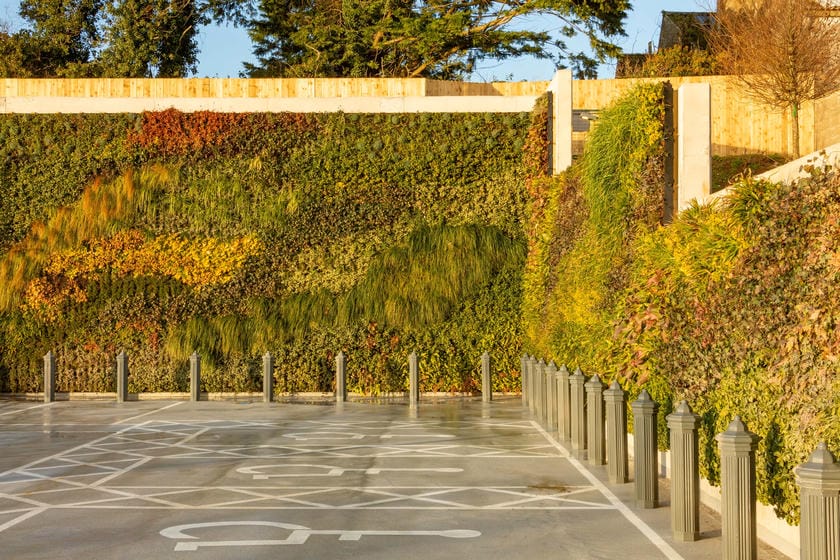
- Open-sided car parks: Living walls can be incorporated in car parks where compliant measures are in place, such as using a non-combustible backing board or fixing to concrete or steel structures with sufficient fire resistance.

For institutional residential buildings such as hotels and boardng schools, case-by-case approval is required. For residential buildings taller than 11m, living walls are prohibited.
How to reduce fire risk of a living wall
Viritopia collaborated with the Fire Protection Association, RISCAuthority, and other living wall providers on Green and Living Walls as External Cladding: A Joint Guide to Managing Risk.
The guide outlines 19 core principles of living wall fire risk mitigation, covering stakeholder engagement, materials, design, and upkeep. We highly recommend reading the core principles for a comprehensive view of what fire-safe living walls look like in practice.
Read om below how Viritopia puts these principles to work on our projects.
How Viritopia designs living walls for fire safety
We minimise risk through a combination of thoughtful design, feasibility planning, and ongoing care.
Fire-safe materials and fixings
Living wall modules should be fixed to a non-combustible build-up such as masonry, concrete, a fire-safe insulation panel, or a steel frame. Viritopia uses an Obex fire classified membrane as a separation layer between the modules and façade. Cavity barriers provide additional protection, and we also use calcium silicate boards to help prevent fire spread.
Fire breaks
Fire breaks interrupt the continuity of planting to limit fire spread. Fire breaks can take several forms, such as steel barriers between storeys or natural gaps in the planting design. Natural fire breaks are often preferred, as they carry no additional embodied carbon cost.

Strategic plant selection
Avoid plant species with significant potential to become flammable, such as:
- Grasses, which require drier soil conditions and ignite more easily
- Plants with high oil or resin content, such as rosemary and lavender
Prioritise evergreen varieties with low calorific value and limited leaf or seed drop in your plant palette.
Irrigation and maintenance
Living walls should be kept at around 45% moisture content, which is Maintaining substrate moisture at 40-45% is a regulatory requirement and the condition under which our modules were fire tested. Below that threshold, combustibility increases significantly. Above it, plants are at risk of root rot — so the correct calibration is critical.
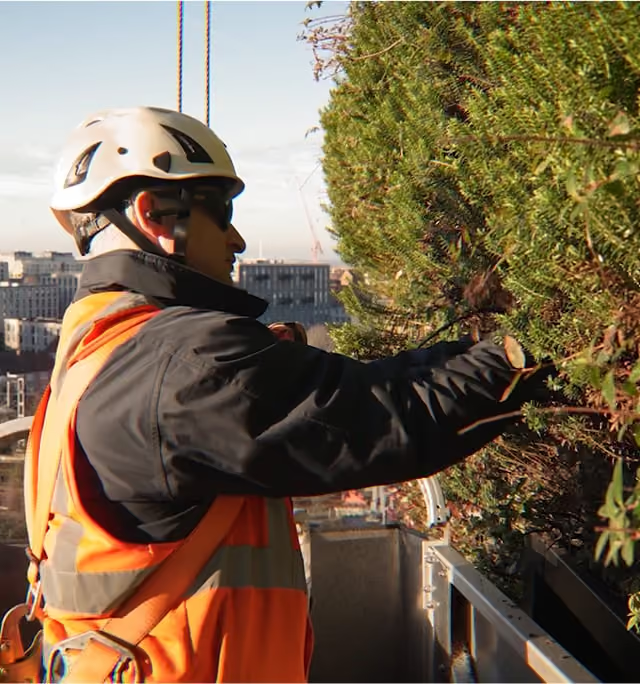
Our irrigation systems are connected via GSM or Wi-Fi, allowing 24/7 remote monitoring. If a fault is detected, our maintenance team receives an alert right away so that they can resolve it immediately.
Beyond irrigation system monitoring, a living wall maintenance plan should account for:
- Regular checks of plant health and substrate moisture levels
- Removal of dead or dry plant material, which can become flammable
- A graded response protocol for faults, with defined timelines for minor and major issues
Our ongoing commitment to fire safety
Safety is our priority at Viritopia. We enthusiastically support the development of the highest safety standards possible for living walls and all green infrastructure. We have developed a stainless steel module for enhanced fire performance and have engaged researchers to explore testing approaches that go beyond the current UK standard.
We welcome the creation of a dedicated fire testing standard for green walls and would gladly participate in the process. In the meantime, we go above and beyond existing requirements to confirm the safety of our systems.
Have a question about our living wall fire rating or specification? Get in touch with a member of our team.
Disclaimer
The Viritopia Living Wall System® (formerly known as the ANS Living Wall System®) has been assessed in accordance with EN 13501-1 and likely achieves a reaction to fire classification of B-s2, d0, based on representative system build-ups.
Due to the nature of living wall systems, including live planting and variable moisture content, full classification testing in strict accordance with standardised methods is not always achievable. Fire performance is therefore determined through independent engineering assessment, undertaken in accordance with the principles of EN 13501-1.
The classification is applicable only to the system configuration as tested and assessed, including module type, substrate, planting, support structure, and irrigation regime. Specification or compliance decisions should be verified against the relevant fire test reports and engineering assessments, which are available on request.
This article is intended as general information only and does not constitute professional fire safety advice. Always consult a qualified fire consultant for project-specific guidance.

Explore more insights
Discover the latest in green infrastructure
Urban Greening: How Cities Are Turning Grey Into Green
Viritopia’s New Guide Explores the Role of Living Walls Amidst Draft London Plan Consultation
The Viritopia® Living Wall System Achieves a Verified EPD
Living Walls & Green Roofs for Urban Water Management
Biodiversity Net Gain: What It Means & How It Works
Responding to the Minister for Housing and Planning: Open Letter

