
Researching the ability of plants to reduce indoor pollution

Researching the ability of plants to reduce indoor pollution
Viritopia and Greenwich University are once again partnering to carry out research, this time investigating the potential for living walls to reduce airborne volatile organic compounds (VOCs).
These are compounds that easily become vapours or gases. Released from burning fuel such as gasoline, wood coal or natural gas, they are also released from many seemingly harmless day-to-day consumer products, for example:
- Copy machines
- Printers
- Computers
- Air fresheners
- Paints
- Hobby and craft supplies
Since people spend up to 90% of their lives indoors, the quality of indoor air is critical to human exposure to pollution. Indoor pollution is composed of myriad constituents, which include oxidants and irritants, VOCs, and particulate matter (PM), much of which is produced by the indoor environment itself. VOCs, which result from continuous emissions from building materials and furnishings, are a primary cause of many sick building syndrome (SBS) symptoms and other health problems associated with indoor air. Oxidation of VOCs can also produce secondary organic aerosols, which compound the PM burden.
To reduce VOCs and other indoor-sourced pollutants, buildings use mechanical ventilation air exchange in order to replace stale indoor air with fresh air from the outdoors. Higher ventilation rates have been correlated with lower absenteeism and SBS symptom incidences, reductions in perceptions of odours, and increased task performance. However, increased ventilation may augment the indoor concentration of outdoor-sourced pollutants, such as ozone and PM, and also uses more energy, as outdoor air must be conditioned to be thermally comfortable.

To address these drawbacks, alternative means of purifying indoor air to replace or supplement ventilation air have been investigated. Over the past three decades, numerous studies have demonstrated the potential for various types of plants to reduce concentrations of indoor airborne VOCs. However, a recent paper has challenged the validity of these studies, since they were carried out in sealed chambers in conditions which do not scale up to the conditions of real indoor environments, which have high air exchange rates, large volumes, and persistent VOC emissions.
This proposal concerns the first stage of a long-term project to evaluate the potential for living walls to reduce indoor air pollution.
Working with Greenwich University, we plan to conduct a real indoor environment experiment using a living wall unit. VOC readings will be taken using a calibrated photoionization detector (PID) for two weeks before the installation of the living wall and for two weeks afterwards, in order to establish the effect of the living wall on the reduction of VOCs. The potential energy savings in reduced ventilation will be calculated, and a survey will be conducted to evaluate people’s perception of the effect of the living wall on air quality.
A future progression on the project will involve an investigation of the efficiency of different types of living wall substrate on the reduction of VOCs, since the botanical uptake of VOCs largely occurs in the root zone where the diversity of microbial species in the rhizosphere is thought to be a key parameter.
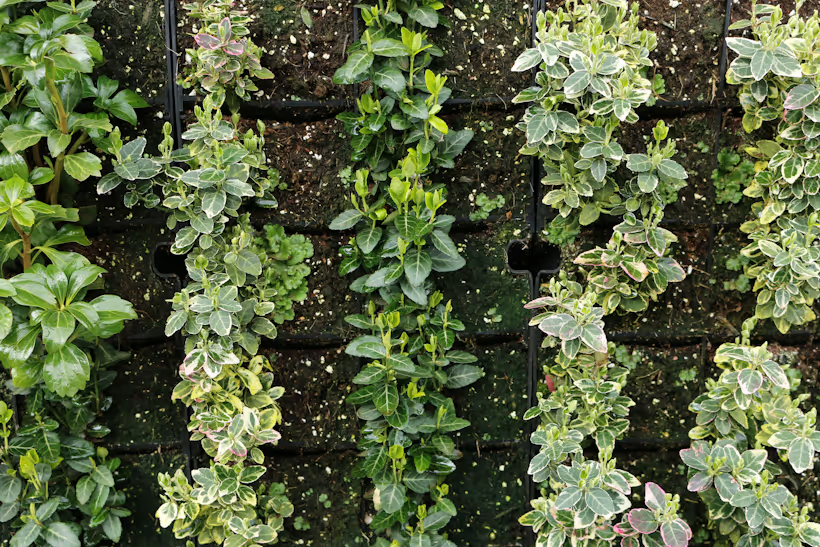
We’ll be publishing these results in May – June and use the findings to improve our interior living wall offering and affect noticeable differences as we help create healthier and happier spaces.

Explore more insights
Discover the latest in green infrastructure

Your Living Wall in the Spring: What to Expect

Your Living Wall in Winter: What to Expect

What Is Environmental Architecture and Why Is It Important?

Holistic Architecture: A Whole-System Approach to Design
Urban Greening: How Cities Are Turning Grey Into Green

Viritopia’s New Guide Explores the Role of Living Walls Amidst Draft London Plan Consultation

