
Responding to the Minister for Housing and Planning: Open Letter
In March 2026 we responded to the National Planning Policy Framework (NPPF) consultation. We are now following up with an open letter to the Minister of Housing and Planning, with industry support - including a number of other living wall providers.
A key observation within the proposed NPPF is the absence of clear, actionable guidance on green infrastructure, despite its potential to deliver significant environmental and social value across our urban environments. When it comes to changing policy and changing perspectives - it's important we work together.
The full open letter is below - if you are in agreement, please consider sharing this and submitting your details on Earth Day (22nd April) to show your support for our planet and its people.

Living Walls Are Climate Infrastructure: It’s Time for National Policy to Recognise Them as Such
An Open Letter to the Minister For Housing and Planning
22 April 2026
Dear Minister,
We write to you at a pivotal moment for our industry and for the future of our cities.
We are a coalition of living wall providers, green infrastructure specialists, and architectural practices. Together, we have delivered hundreds of projects across the United Kingdom and internationally, using building facades to clean the air, cool urban spaces, support biodiversity, and improve the quality of life for the communities around them.
We welcome the Government's ambition to reform the planning system in ways that work for both nature and economic growth. The revised National Planning Policy Framework is an important step forward, and we are encouraged by its stronger emphasis on green infrastructure, biodiversity, and climate resilience.
But there is a crucial gap.
Living walls and vertical greening systems are not recognised as qualifying green infrastructure in national planning policy. In cities where ground-level space is scarce, building facades are often the only viable surface for meaningful greening. Without explicit recognition in the framework, planners have no clear basis for considering these systems, and developers routinely remove them from schemes to manage uncertainty, even where the environmental case is strong and the technology is proven.
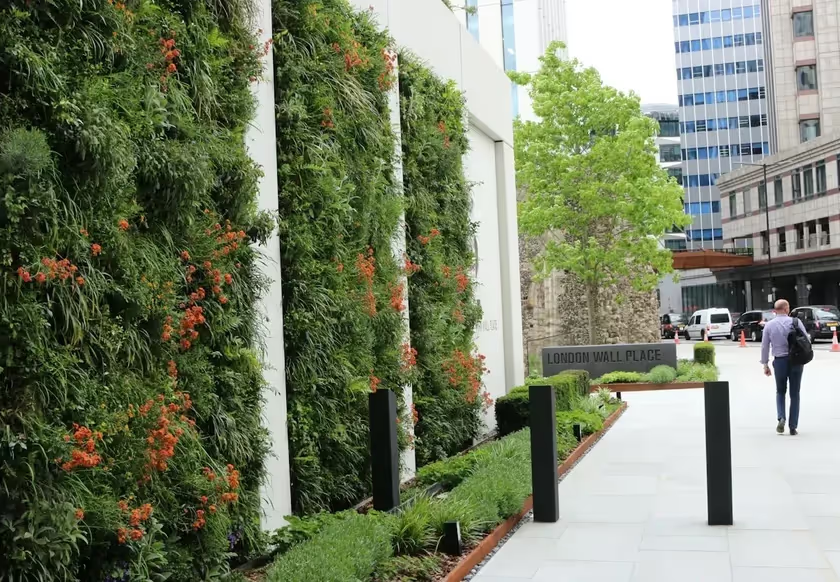
Living walls are not simply aesthetic additions to a building’s façade. Independent monitoring of installations across the UK has recorded measurable improvements in air quality, reductions in surface water runoff, contributions to urban cooling, and direct support for biodiversity. Living walls are functional climate infrastructure, proven tools for delivering the measurable environmental and resilience outcomes our cities urgently need.
The urgency of acting could not be clearer. Last month, UN Secretary-General António Guterres declared that the global climate is in a state of emergency, warning that “every key climate indicator is flashing red.” The solutions exist. Planning policy must ensure they can be deployed.
We are making a single, specific request: the revised framework should explicitly recognise living walls and vertical greening as qualifying green infrastructure. Inclusion of this clear acknowledgement would:
- Give local planning authorities clear, consistent basis on which to consider vertical greening as part of any development.
- Unlock the use of building facades - often the only available surface in dense urban environments - as productive green space.
- Ensure that biodiversity, air quality, and climate resilience objectives are delivered using the full range of proven solutions available.
- Support the delivery of nature recovery priorities on constrained urban sites where no ground-level greening alternative exists.
- Close the coherence gap between the Government's environmental ambitions and the tools available to planners and developers to deliver them.
This requires no new powers, no additional funding, and no regulatory burden. It would simply ensure that the framework reflects the full range of infrastructure available to meet the Government's own goals.
The evidence is there. What is needed now is the political will to ensure the planning framework keeps pace with the climate emergency we face.
Yours faithfully,
- Steve McIntyre, Principal Urban Environmental Consultant, Viritopia
- Stuart Fraser, Partner, Make Architects
- Andrew Robinson, Sustainability and Carbon Strategy Director, Carbon Sense
- Mark Cridge, Executive Director, National Park City Foundation
- Matt Lindsay, Director, Growing Revolution Ltd
- Thomas Ward, Country Manager, Terapia Urbana
- Tristan Kelly, Associate, Reid Brewin Architects
- Amos Wilkinson, Head of Business Development, Maple Sunscreening Ltd
- James Beattie, Managing Director, Pritchard and Pritchard
- Joe Jackson, Principal Landscape Architect
- Brian Bailey, Senior Lecturer - Environment, Geography and Geosciences, University of Portsmouth
- Cliff Burke, Founders Associate, Pollinatework
- Bruce Calton, Head of Urban Design, UMC Architects
- Laura Percy, Development Director, Muse Places
- Richard Sabin, Green Infrastructure Consultant, Eco Green Group
- Professor Ross Cameron, Professor of Environmental Horticulture
- Dr Mohammad Tammo, Senior Lecturer & Architectural Design Programme Leader
- Shane Frost, Technical Director for Blue and Green Infrastructure
- Gerry Wanstall, Biophilic Design expert
- Gary Grant, Ecologist & Green Infrastructure Consultant
We'd like to thanks Viya Nsumbu, Founder and Director of POLELE, for her ongoing PR support and communciation strategy. Her expertise has proved invaluable in sustaining momentum and turning our voice into visibility with the London planning and architecture community.

Explore more insights
Discover the latest in green infrastructure
Understanding living wall fire regulations

